Study Abroad
Universities in the UK for Nepali students: UCAS vs direct applications, entry after NEB +2 or a Nepali bachelor's, IELTS/PTE, intakes, CAS and scholarships.
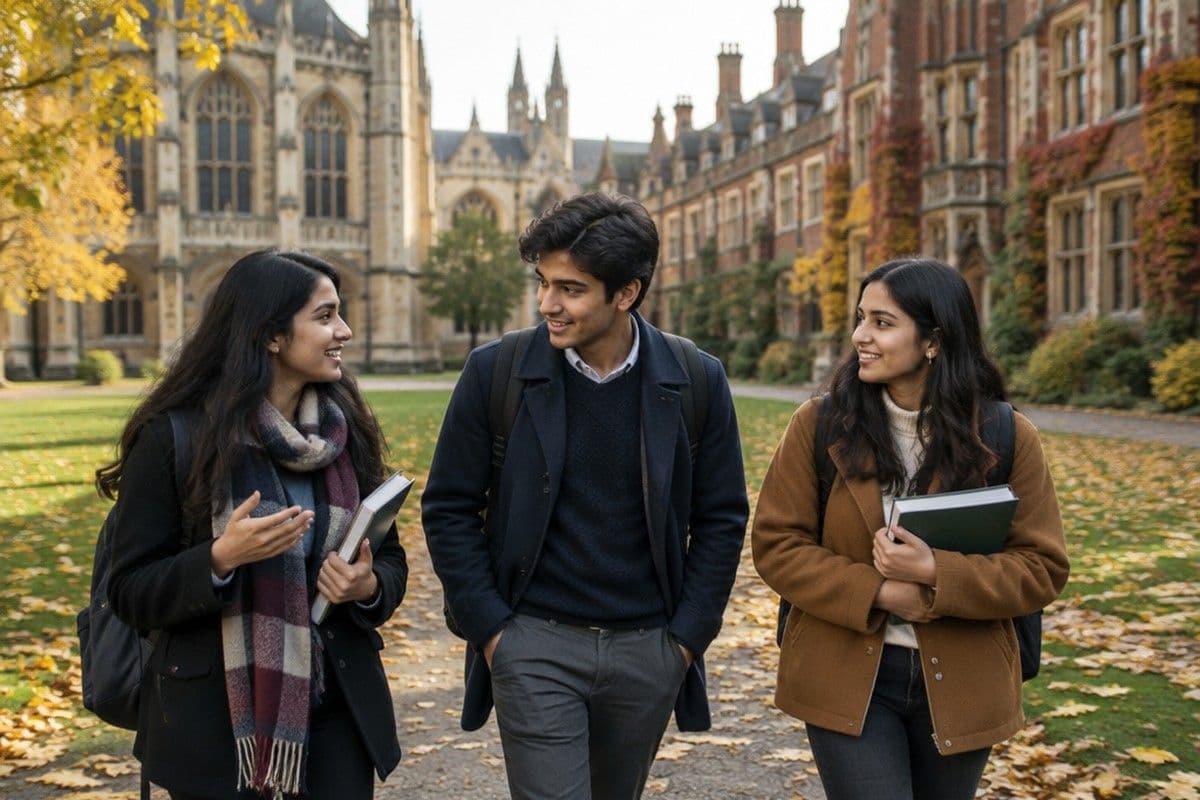
When Nepali students research universities in the UK for Nepali students, the real questions are practical. Can you start a bachelor's straight after NEB +2, or do you need a foundation year first? Will a three-year bachelor's from Nepal be accepted for a master's? Which English test should you take, and when should you apply?
This guide uses official sources: GOV.UK, UCAS, the British Council and the Nepal pages of named UK universities. Rules change every year, so confirm them for your exact course before you apply.
There are two main routes, depending on your level of study.
Undergraduate (bachelor's) through UCAS: Most full-time undergraduate applications go through UCAS, the UK's central admissions service. One application lets you choose up to five courses. For 2027 entry, UCAS lists the application fee as GBP 34.50. The main 2027 dates are:
15 October 2026 (18:00 UK time): Oxford, Cambridge and most medicine, dentistry and veterinary courses
13 January 2027 (18:00 UK time): the "equal consideration" date for most other undergraduate courses
30 June 2027: the last date before late applications go into Clearing
UCAS notes that many universities accept international applications later in the year, but popular courses fill up.
Postgraduate direct to the university: For most taught master's courses, you apply on the university's own portal. Each university sets its own deadlines, and some close earlier for applicants who need a visa.
This is where UK universities differ most. Here is what four universities publish on their Nepal pages:
University of South Wales: NEB or HSEB Grade 12 with 65% or above, or a CGPA of 2.8 or above, is considered for direct entry to Year 1 of a bachelor's. Students who do not meet this can take a Foundation Year.
University of Plymouth: Grade XII or HSEB with a GPA of at least 2.8 is required. Applicants who fall short can take a foundation option through the university or the University of Plymouth International College.
University of Sheffield: NEB students are considered for undergraduate entry after they complete an approved foundation programme, such as the International Foundation Year at Sheffield International College.
University of Nottingham: A foundation course is required for all students with a Year 12 Higher Secondary Certificate. These run at the University of Nottingham International College.
What this means for you: A strong +2 result can open direct entry at some universities, while others expect a foundation year, which adds a year of fees and living costs. Some pathway colleges offer an "International Year One" instead. Course-specific rules, such as maths for engineering, come on top.
Most taught master's courses last one year. Universities convert your Nepali percentage or GPA into a UK class, usually a 2:1 or 2:2, and they differ on three-year degrees:
University of Nottingham: Accepts a three-year or four-year bachelor's taken after 10+2 from a recognised Nepali university. Its guide equates a 2:1 with 65%-79% (First Division) or a GPA of 3.2-3.59, and a 2:2 with 60%-65% or a GPA of 3.0-3.19.
University of Sheffield: Usually asks for a four-year bachelor's, or a three-year bachelor's followed by a two-year master's. For a four-year degree, a 2:1 is listed as Distinction or 70%. Sheffield International College also offers Pre-Masters programmes.
University of Plymouth: Asks for a four-year bachelor's or a master's. It lists a First Division GPA of 3.3-3.6 as equivalent to a 2:1.
University of South Wales: Asks for at least 60% from a three-year BA or 55% from a four-year BE/BTech.
If you hold a three-year degree, check each Nepal page before you shortlist.
The visa rule: GOV.UK says that for study at degree level or above you need English equivalent to CEFR level B2. For courses below degree level, such as many foundation programmes, the level is B1. For degree-level study, your university (the Higher Education Provider) can assess your English itself, so it may accept a test such as IELTS Academic or PTE Academic at B2 level. Otherwise you need a Secure English Language Test (SELT), such as IELTS for UKVI or PTE Academic UKVI.
The university rule: Sheffield's Nepal page gives a minimum of IELTS 6.0 (or equivalent) for bachelor's degrees and 6.5 for master's, with some departments asking for more. South Wales asks for IELTS 6.0 overall with at least 5.5 in each band. It also accepts Grade 12 English of 65% or more with a medium-of-instruction letter. Always check sub-scores on your course page.
Not sure which test suits you? Our IELTS vs PTE guide explains the differences between the two tests.
According to the British Council's Study UK site, the UK academic year starts in September or October. September is the main intake with the widest choice.
Many universities also offer a January intake, especially for taught master's courses. For example, the University of Kent's January 2027 term starts on 11 January 2027, with an application deadline of 27 November 2026 for taught postgraduate and undergraduate courses. A few run February or May starts; the University of South Wales mentions February 2027 starts.
For a September start, apply between October and March if you can. That leaves time for your deposit, CAS, the 28-day funds rule, TB test and visa.
You can only get a UK Student visa if your university is a licensed student sponsor. After you accept an unconditional offer and meet its conditions, the university issues a Confirmation of Acceptance for Studies (CAS). Many universities ask for a tuition deposit before issuing a CAS. The University of South Wales says students based in Nepal must pay 100% of their tuition fees to be eligible for a CAS, so check each university's deposit rule early.
Before you pay anything, check the university on the Home Office Register of licensed sponsors: students on GOV.UK. Licences can be suspended. On 30 September 2026 the Home Office suspended Buckinghamshire New University's student sponsor licence, and it was still missing from the register published on 3 November 2026. Read about the Buckinghamshire New University sponsor licence suspension.
For the full visa process, read our UK student visa from Nepal guide.
After a degree from a compliant UK university, you can usually apply for the Graduate visa. It lasts two years if you apply on or before 31 December 2026, and 18 months if you apply on or after 1 January 2027. PhD graduates get three years. Most new students will apply in 2027 or later, so plan around 18 months. See our UK Graduate visa guide.
Chevening Scholarships: These UK Government awards are open to Nepal and fund a one-year master's for applicants with work experience. The 2027-2028 round has closed.
GREAT Scholarships: For 2026-27 the British Council lists 18 eligible countries, and Nepal is not one of them. Check future lists.
University scholarships: These are the most realistic option for most students. The University of South Wales lists a scholarship of GBP 2,500 a year for self-funding students from Nepal on courses starting in September 2026 and February 2027. Nottingham lists South Asia Undergraduate and Postgraduate Excellence Awards. Amounts and deadlines change each year.
Start with your result. Compare your +2 percentage or GPA, or your bachelor's GPA and degree length, with each university's Nepal page.
Decide between direct entry and a foundation year or pre-master's, and include the extra year in your budget.
Check your English plan against the course page, and decide whether you need a SELT.
Confirm the university is on the student sponsor register, and check its deposit and CAS rules.
Compare the total cost, not just tuition. Our cost of studying in the UK guide shows how to budget for maintenance funds, the visa fee and the IHS.
Pick an intake that leaves enough time for the 28-day funds rule and your visa.
Be wary of "guaranteed admission" claims. If you plan to work while studying, read our guide to part-time work in the UK for Nepali students. If you are comparing destinations, see our guide to universities in New Zealand for Nepali students.
At some universities, yes. The University of South Wales considers NEB results of 65% or a CGPA of 2.8 for direct entry, and Plymouth asks for a GPA of 2.8. Others, including Sheffield and Nottingham, ask Nepali +2 students to complete a foundation programme first.
It depends on the university. Nottingham and South Wales accept three-year degrees. Sheffield usually wants a four-year degree, or a three-year degree plus a master's, and Plymouth asks for a four-year degree. A pre-master's programme can help if your degree is not accepted.
Many universities ask for IELTS 6.0 for a bachelor's and 6.5 for a master's, with minimum band scores, but some courses ask for more. For the visa, degree-level study needs English at CEFR B2, and your university can assess this.
September offers the most courses. January suits some master's and undergraduate students but has fewer course options. Whichever intake you choose, apply early enough to meet the deposit, CAS and 28-day funds deadlines.
Not in 2026-27, because Nepal is not on the British Council's eligible country list for that year. Chevening and university scholarships remain open to Nepali applicants.
Everest Global Education helps Nepali students match their +2 or bachelor's results with UK universities. We check whether you qualify for direct entry or need a foundation year or pre-master's, and we confirm that each university is a licensed student sponsor. We also plan your intake around the CAS and 28-day funds rules and provide IELTS and PTE preparation. All advice is checked against current GOV.UK guidance and each university's Nepal entry page. Our counselling is delivered from our offices in Nepal and Australia.
Kathmandu: Putalisadak, Opposite of MIT College
Pokhara: Pushpa Ratna Bhawan, Siddharthachowk-4, Pokhara 33700
Beni: New Road, Beni Bazar, Myagdi
Dhangadhi: Boradadi Road, Dhangadhi 10900
Janakpur: Girija Path, Murli Chowk, Janakpur
Perth (Australia): 102 James St, Northbridge WA 6003, Australia
Sydney (Australia): Level 1/483 Princes Highway, Rockdale NSW 2216, Australia
Share your transcripts, English score, preferred course and budget, and we will help you shortlist UK universities that match your results and plan your entry route before you apply.
Submit an enquiry at https://everestglobaledu.com/enquiry and our team will contact you by phone or email.
Everest Global Education
Phone: +61 8 6157 0080
Email: info@everestglobal.com
Website: https://everestglobaledu.com/
Share this post
The latest news, technologies and resources from our team.
 View all